Falcon Heavy Flies Its First NRO Mission, Reusing Two Side Boosters Flown 32 Days Earlier
Hardware / news
Falcon Heavy Flies Its First NRO Mission, Reusing Two Side Boosters Flown 32 Days Earlier
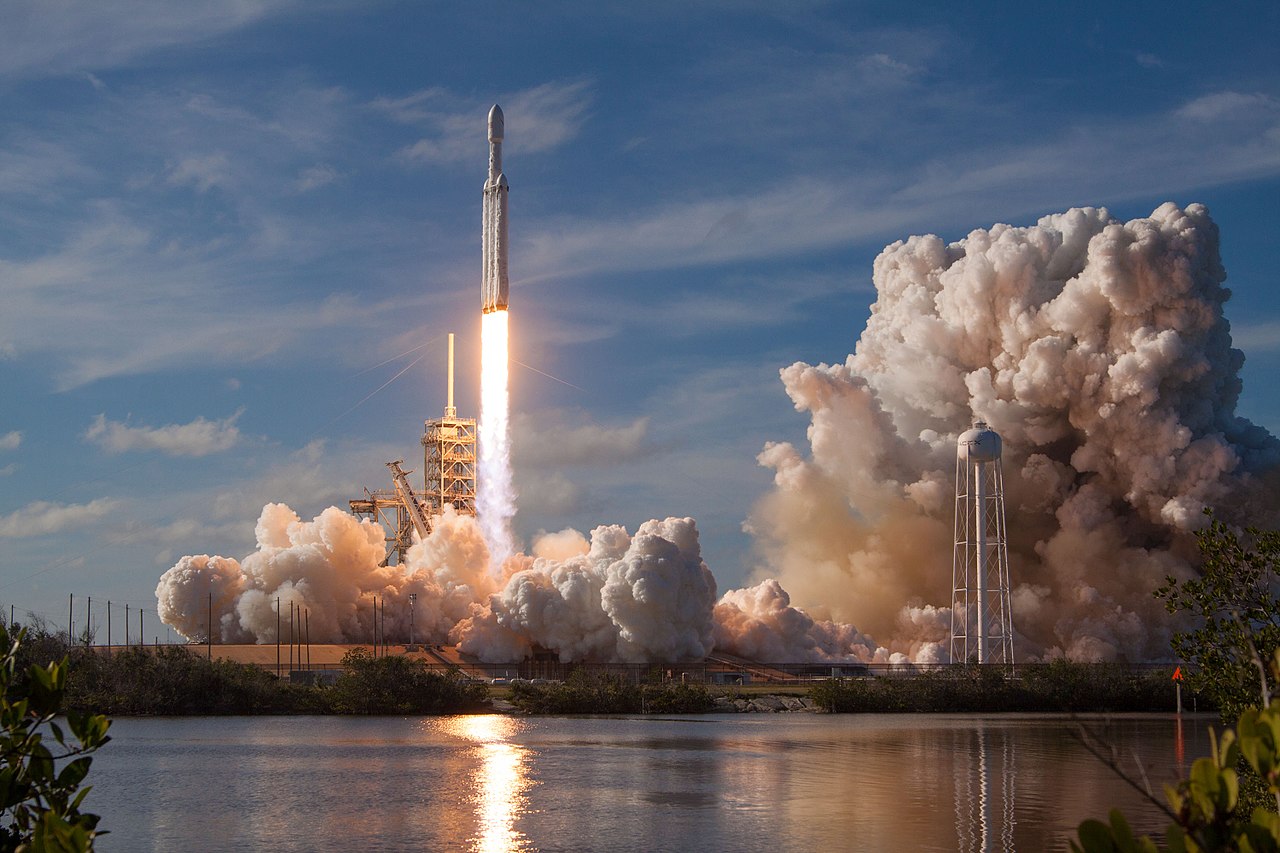
NROL-97 lifted off from Pad 39A at 11:54 p.m. EDT on Oct. 1, the 14th Falcon Heavy flight, with a brand-new center core that was not recovered.

SpaceX launched NROL-97 on a Falcon Heavy at 11:54 p.m. EDT on Oct. 1, 2026 (0354 UTC on Oct. 2) from Launch Complex 39A at Kennedy Space Center. It is the first time the National Reconnaissance Office has put a payload on the three-core rocket, according to Spaceflight Now, and the 14th Falcon Heavy flight overall.
What the payload is has not been published. The mission is classified, and the reports describe only a north-easterly trajectory out of Florida's Space Coast.
The booster ledger
The two side boosters were reused. B1104 was on its second flight and B1072 on its fourth, and Spaceflight Now reports both had flown a month earlier on NASA's Nancy Grace Roman Space Telescope mission. Counting from Aug. 30 to Oct. 1 gives 32 days between flights for each. Both landed at Landing Zones 1 and 2 at Cape Canaveral Space Force Station, per the same report and AIAA.
The center core, B1106, was new and was expended, so it did not return. Falcon Heavy is powered by 27 Merlin 1D engines.
- B1072 (side)4 flights
- B1104 (side)2 flights
- B1106 (center, expended)1 flights
Source: Spaceflight Now, Oct. 1, 2026, accessed 2026-10-03
The asymmetry is the cost structure of the rocket. Two of three cores come back and fly again within a month; the center core is thrown away. A payload that needs Falcon Heavy is paying for one new core per flight whatever the side boosters do.
How the NRO bought it
Spaceflight Now says the mission was procured in 2025 under the National Security Space Launch Phase 3 Lane 2 contract, which is a competitive award. Before this flight the NRO had used 22 Falcon 9 launches. The payload fairing had flown before too, on the NROL-95 mission in July 2026.
SpaceX also launched three Falcon rockets on Oct. 1 and landed four boosters in one day, which Spaceflight Now calls a company first.
| Item | Detail |
|---|---|
| Launch | 11:54 p.m. EDT, Oct. 1, 2026, Pad 39A |
| Falcon Heavy flight | 14th |
| Side boosters | B1104 (flight 2), B1072 (flight 4), both landed |
| Center core | B1106, new, expended |
| Contract | NSSL Phase 3 Lane 2, procured 2025 |
What is not known
The reports give no payload mass, no target orbit and no price for the launch. Nor do they say whether the NRO asked for the flown boosters or accepted them. Without those, the 32-day turnaround is a statement about SpaceX's cadence, not about what the customer paid.
For other launch coverage on the site, see China's launch cadence for the fourth quarter and the orbital-compute prototype in Google's Suncatcher story.
What would change this read is a second NRO Falcon Heavy contract appearing in the Phase 3 Lane 2 task orders; one flight does not make a pattern.
Sources
More in Hardware
- 01YMX Signs Five-Year Deal to Run Outrider's Self-Driving Yard Trucks, With No Fleet Size GivenThe logistics operator will put Outrider's autonomy on its Orange EV electric trucks in customer yards from 2026. The announcement gives no truck count, price or site.
- 02Valve's Timur Kristóf Got a 14-Year-Old Radeon HD 7870 XT Working on LinuxA Valve driver engineer's patches moved Radeon HD 7000 and R9 200 cards to amdgpu by default in Linux 6.19, with a reported 30% uplift and a fix for a card that never worked.
- 03Homa Claims 13x Better Tail Latency Than TCP for AI Clusters. Read the Conditions FirstStanford's John Ousterhout told the AI Engineer World's Fair that TCP and RoCE suit bulk transfers, not millisecond-scale AI traffic. His own caveats are the useful part.
- 04Google's Lincoln Data Center Peaks at 52.65 MW, a Redaction Error ShowsGoogle called the figures trade secrets. Copying text from under the black boxes in a Nebraska state filing produced them, along with $117.6 million in expected tax refunds.