Anthropic Says Claude Cut Quantum Circuit Gates 17x on One Task
A.I. / news
Anthropic Says Claude Cut Quantum Circuit Gates 17x on One Task
A paper with Harvard's Susanne Yelin and Mikhail Lukin reports Claude designs beating published circuits on eight tasks, with some gains of an order of magnitude or more.
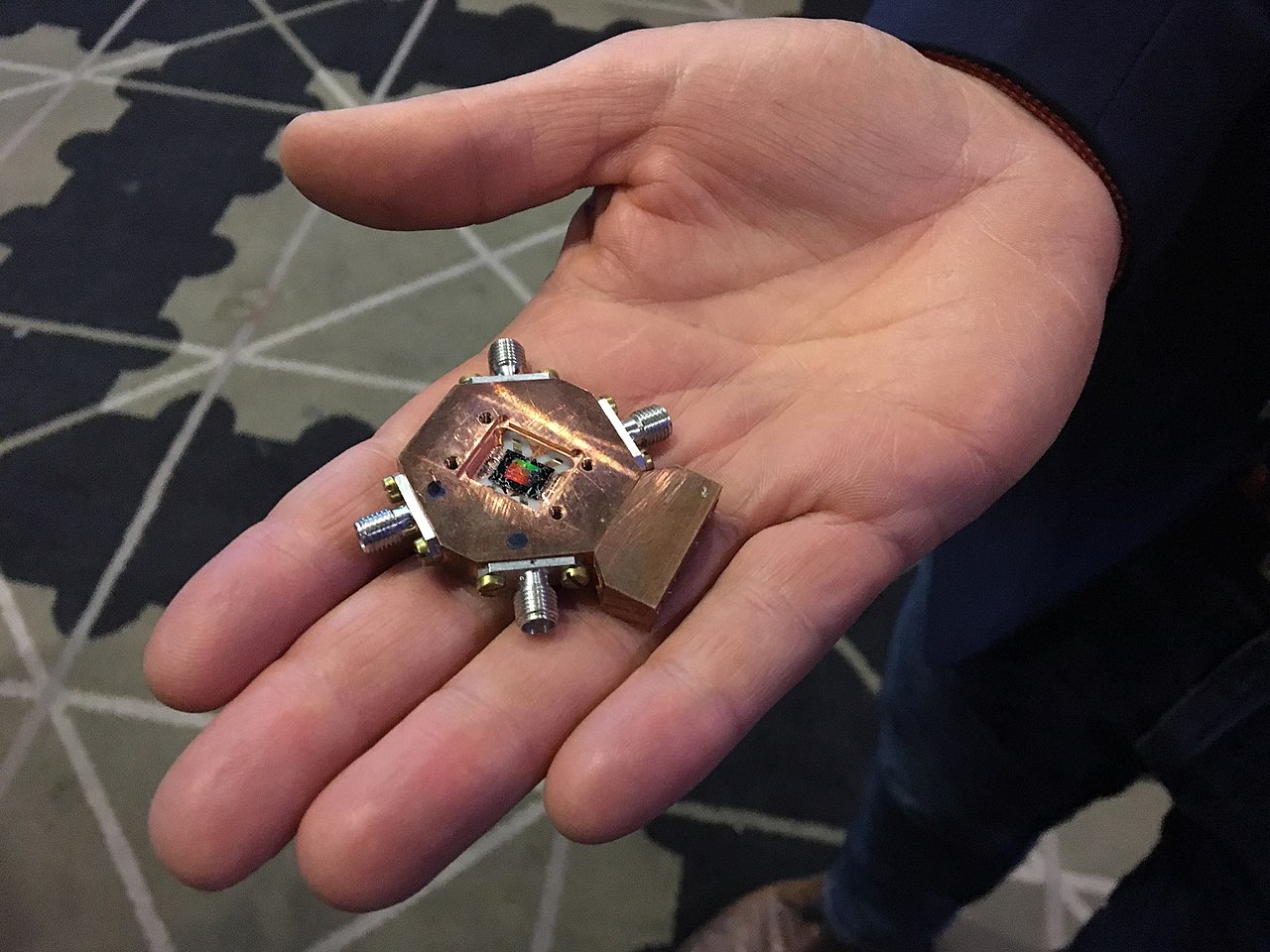
Anthropic said Oct. 16 that Claude designed quantum circuits using fewer qubits and fewer gates than the best published designs on all eight tasks it was given, including one elliptic-curve design with 17 times fewer gates. The company's research post points to a paper, arXiv:2610.22367, submitted Oct. 15.
The work was led by Andi Gu in Anthropic's STEM Fellows Program and mentored by Alek Kemeny, a quantum physicist at Anthropic. Susanne Yelin of Harvard and Mikhail Lukin, of Harvard and QuEra Computing, are co-authors on the paper. Both the post and the paper are the authors' own account.
How the loop worked
Claude received plain-language specifications for eight circuit primitives spanning chemistry, optimization, physics simulation, number theory and numerical computing. An automated evaluator checked each proposed circuit for correctness and scored it by qubits multiplied by gates, a proxy for runtime. Claude then revised its designs from that feedback with no human input between rounds.
Humans still shaped the run. Anthropic said the team supplied the initial brief and occasional nudges, and that Claude was conservative, repeatedly second-guessing itself and favouring well-known approaches. The team required several distinct approaches in parallel to counter that.
The two results with numbers
The elliptic-curve task, point addition, took Claude about 53 hours. It built a reversible version of divsteps, a modular-inversion method, that reconstructs branch information from the numbers instead of storing it. One resulting design uses 12 percent more qubits than the smallest earlier design and 17 times fewer gates. Verification used large numerical simulations at 256 bits and a Lean formalization.
The second result is a Reed-Solomon decoder for the optimal polynomial intersection problem within DQI. Claude swapped the extended Euclidean algorithm for Berlekamp-Massey and recomputed temporary values instead of keeping them. The decoder reserves 19 qubits, against 665 in the worst case, and uses about 12 times fewer gates than Google Quantum AI's earlier construction. Across 403 million sample decodings, it failed about once in 10,000 runs.
| Task | Reported change |
|---|---|
| Elliptic-curve point addition | 12% more qubits, 17x fewer gates |
| Reed-Solomon decoder (DQI) | 19 qubits vs 665 worst case |
| Same decoder vs Google Quantum AI | About 12x fewer gates |
The arXiv abstract is more guarded than the post. It says seven of the eight tasks produced circuits with reduced Toffoli and qubit counts compared with the state of the art, and that the eighth produced a new architecture for prime-field modular inversion. The abstract gives no percentage reductions.

What it does not show
Anthropic said circuit design is one part of a fault-tolerant quantum computer. Error correction, decoders and hardware control are separate problems. The post also reproduces a history for FeMoco, a chemistry target: the Toffoli estimate fell from about 50 trillion in 2017 to about 340 million in 2025, roughly 150,000-fold. Anthropic credits that to many researchers' algorithmic work, not to Claude.
The numbers also do not say how many qubits an attack on a real elliptic-curve key would need. Neither the post nor the abstract gives that total.
For related reading, see the site's earlier report on Anthropic's NIST curve seed bounty and on Google's magic state cultivation result.
The paper is version 1 on arXiv, 46 pages with 10 figures and six tables, so any revision will carry a new version number.
Sources
More in A.I.
- 01Qwen3-4B-Deslop Cuts Its Slop Score From 121 to 12.5 on a MacBook Air, and Two of 40 Answers Came Out DamagedThe Show HN fine-tune by Erik Markus Kannike uses a rank-16 LoRA and a 175-byte neuron edit; its blog gives no licence, its Hugging Face card says Apache-2.0.
- 02HybridAgent Paper Claims 10.4% Gain and 2.7x to 3.7x Lower Cost, but Its Own Text Gives 10.4% Two Different MeaningsThe Stanford, UIUC and Together AI preprint ships MIT-licensed 8B and 14B agents, and no independent run of its numbers has been reported.
- 03Gemini 4 Argon Reaches the API at $2 and $10 Per Million Tokens, With a No. 1 Ranking and No ScoreGoogle's October 13 post says Argon tops the Vals Index but publishes no figure for it, and the introductory price doubles on November 30.
- 04DeepSeek Swapped V4.1-Flash-1017 Behind Its API Name, and the New Card Lists NL2Repo at 65.4 Where the Old One Said 64.0The MIT-licensed update calls itself minor and is now what deepseek-flash serves, with no active-parameter count and no release date on the card.